

Wondering how to plan a road trip to Europe? Having spent ten weeks on a road trip in Europe, I’m well-positioned to write about the best way to plan a trip.
I went through all the pre-planning steps, from creating a realistic budget to choosing the best insurance and making sure all the essentials were covered.
My European road trip was amazing, and I had an incredible time. If you’ve been thinking about this, you need to do it!
I researched a lot online, but by taking the road trip myself, I learned so much more and took home invaluable insights to create this Europe road trip planner.
This post is a complete step-by-step guide to planning a road trip to Europe. I’ve included tips and strategies I learned along the way, which I’m sharing to ensure you have all the information you need to plan the perfect trip.


Overview: Planning A Road Trip To Europe
If you’re short on time, these are the seven steps to planning an epic road trip in Europe!
- Decide your trip length and route: figure out how long you have and what countries or regions you want to explore.
- Choose your vehicle: pick the best way to travel (car, campervan, motorbike) based on comfort, luggage and itinerary.
- Sort insurance and breakdown cover: make sure you’re covered for health, car insurance and roadside rescue across Europe.
- Plan your accommodation: decide on hotels, campsites or van stays and whether to book in advance.
- Book key attractions and excursions: pre-book busy sights and tours to save time and avoid sold-out tickets.
- Get visas and documentation ready: check immigration requirements, driving permits and all paperwork before you go.
- Budget everything: estimate fuel, tolls, accommodation, food and extras so you travel without surprises.

Key Questions To Ask Yourself BEFORE Going!
Before diving into the details, let’s brainstorm some key questions to ask yourself before you start planning the best road trip in Europe:
What’s my main goal for this trip? Think about it and decide whether you’re looking for scenic adventure, cultural experiences, or a mix of both.
How much time do I have? The time you have available will influence how far you can travel, how many countries you visit, and how flexible your itinerary can be.
What type of vehicle suits my trip? Consider the number of people travelling, luggage space, and whether you’ll need to navigate narrow city streets or stick to the open road.
What’s my budget? Having a clear budget will help you decide whether to stick to main routes or explore off-the-beaten-path areas and whether you opt for campsites, hotels, or budget stays.
What time of year am I going? Do you want to travel in the peak summer months, when the weather is warm but tourist spots are crowded, and prices are higher? Or do you prefer the quieter shoulder seasons like spring and autumn, where you can still enjoy pleasant weather but with fewer crowds?
Do I want to pre-plan everything or be spontaneous? Your travel style will impact how rigid or open your route and daily plans need to be.
❤️ FOLLOW ME ON SOCIALS!
I hope you’re finding this guide helpful! Follow me on Instagram (@abigailcarolina.dalton) and Facebook for daily stories, travel tips and photo dumps!
Your support means the world to me. Thank you 🤗

Something to think about
If you’re focused on sticking to a budget, I’d suggest starting with Step 7. However, if budget isn’t your main concern, deciding on the trip details first and working out the costs afterwards can be a more enjoyable way to plan, in my opinion.
It’s always possible to adjust the itinerary later on by cutting back on stops, attractions, or accommodation choices to fit your budget.
Once you’ve got a clear holiday goal, planning the next steps will be much easier!
You might also be interested in
- Ultimate Northern Italy Road Trip Itinerary: An Epic 8 Weeks + Map.
- Driving In Tuscany, Italy: 15 Tips For A Safe & Happy Journey.
- How To Visit The Borromean Islands.
- 20 Most Beautiful Villages In Alsace, France You HAVE TO Visit!
Step-by-Step: Europe Road Trip Planner
✈️ MAKE TRIP PLANNING EASY!
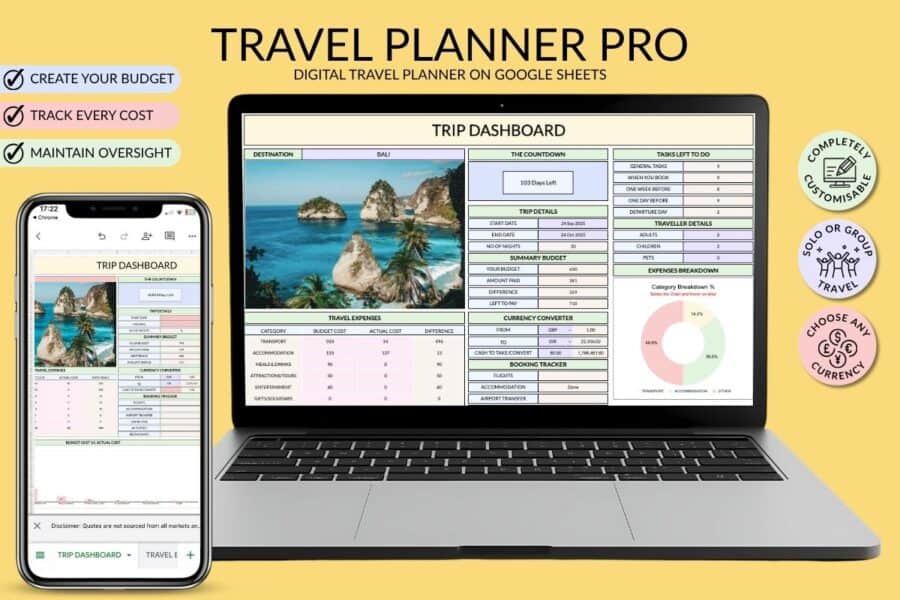
The All‑In‑One Digital Planner is your simple way to keep every trip organised. Track bookings, plan your days, manage your budget, and tick off checklists – all in one colour‑coded Google Sheet you can use again and again. 🤗
Step 1: Length of trip & route planning
I always like to start by deciding how much time I can realistically dedicate to a trip.
Consider whether you want to cover multiple countries or explore a single region in greater depth. Once I’ve set a time frame, planning the route becomes much easier.
Next, figure out which towns or cities you want to visit and how long you will spend in each.
For the best road trips in Europe, research online and get recommendations from people who have been there—this will help you gauge how much time is needed at each stop.
As a rule of thumb, I like to spend at least 2 nights in one place, but in smaller villages, 1 night is enough.
Download the Google Maps app

Get familiar with Google Maps and the areas you’ll be visiting.
I find it helpful to save each location on the map and then zoom out to see where they are in relation to each other.
This helps me visualise the distances between stops and determine the most logical order to visit them, making it easier to plan an efficient itinerary.
I also use the app to calculate the drive time for each leg of the journey.
By doing this for every destination, you’ll get a clear idea of how much time you’ll spend on the road versus how much time you’ll have for exploring.
This helps ensure a balanced itinerary where you’re not stuck driving all day and can fully enjoy each stop along the way!
More thoughts to guide your inner Europe road trip planner:
- What’s your priority: seeing as much as possible or taking a slower pace? Deciding whether you want to hop between destinations or spend more time exploring each area will help you determine how long your trip needs to be.
- Do you prefer sticking to main roads and motorways, or would you rather take scenic backroads? Your preferred driving style will determine whether you opt for faster routes or scenic detours that take you off the beaten path. Keep in mind that the scenic backroads will cost more in fuel.

Keep your route flexible
From the start, I knew we had about ten weeks to explore Europe.
It seemed like plenty of time, so I created an itinerary packed with all the places I wanted to visit—probably a bit too ambitious, to be honest.
If we’d stuck strictly to the plan, we could have done it all. But I’ve always been one to go with the flow.
A few weeks in, it became clear that we wouldn’t have enough time for everything originally planned, mainly because we added extra stops and ended up staying longer in certain areas.
Our road trip naturally evolved from there.
This turned out to be a good thing! We still followed the general route but decided to skip southern Italy entirely, giving us more time to explore the north at a relaxed pace.
As much as I love a well-laid plan, it’s essential to stay flexible.
Plans are there to guide you, not to dictate every move. A fluid itinerary allows for unexpected adventures and changes—something I think makes road trips even more enjoyable.
⭐ Pro tip >> A week might be enough for a couple of countries, but longer trips allow more flexibility and relaxed driving days. Try not to fit too much into a short period and build in buffer time for unexpected delays or spontaneous stops.

Where To Go on a European Road Trip?
I’ve packed tons more helpful information into my Europe road trip itineraries below; check them out, as they’ll help you plan country-specific trips!
Best road trips in Europe:
- France: Alsace’s famous Wine Route
- Italy: Piedmont and the Northern Lakes
- Italy: Liguria and Italian Riviera
- Italy: The rolling hills of Tuscany
- England: The quintessential Cotswolds
Enjoying this blog? All my content is free, but I do spend a lot of time in coffee shops. If you’re finding my content helpful and would like to buy me a coffee, I’d love that! Thank you 🤗
Step 2: Choosing a vehicle
It might seem like an obvious answer, but there is more than one option when planning a European road trip.
We went in our self-converted campervan, which gave us more flexibility, but the choice of vehicle depends on your route, group size, and travel preferences.
Consider these questions:
- How many people are travelling with you?
- How much luggage will you be taking?
- What type of roads will you be driving on?
- How important is comfort to you?
- Are you planning to sleep in your vehicle?
- Are you conscious of reducing your carbon footprint? Hybrid and electric vehicles can be good options if that’s the case.
- What is your budget?

I noticed plenty of motorhomes on the road in Europe, and most European countries are well-equipped for roadside camping.
The UK, however, seems to lag slightly in this area. I think this is the best way to road trip in Europe, although I get it might not be for everyone.
You could also opt for a motorbike road trip.
We travelled from Sierra Leone, in West Africa, to the UK in a tuk-tuk, which is ultimately a motorbike. The journey was surreal, but I found that once we reached Europe, the roads were perfect for motorbikes.
If you don’t have or want to travel to Europe in a campervan, road-tripping in your car or a rental is another excellent option.
Both options have pros and cons, but the biggest drawback is you will have to fork out more for accommodation.
Taking your car is more convenient and familiar, plus you can pack as much as you need. Renting a vehicle, on the other hand, gives you the flexibility to choose something that suits your trip, like a campervan or a smaller car for city-focused trips.
However you choose to go on a road trip around Europe, remember you’ll be spending a lot of time in the car, so it needs to be comfortable. A fuel-efficient vehicle is ideal if covering long distances.
⭐ Pro tip >> If taking your own vehicle, make sure it’s in top condition before setting off, with a service, a tyre check, and enough storage space for luggage.
Step 3: European Insurance and breakdown cover
🛵 BEST CAR RENTAL!
If you want to rent a CAR in Europe, you’re going to need a comfortable vehicle. I recommend Discover Cars they are a popular rental company. 🤗

For those of you who have your own transport, ensure you have comprehensive European car insurance that covers all the countries you’re visiting.
Depending on your vehicle, your insurance company might be able to extend the policy to cover Europe. You’ll have to call them up to check this; there’s typically an additional fee.
We used AdrianFlux Insurance, a specialised car and van insurance company.
Due to our DIY van conversion, we struggled to find an insurance company that would cover us, but in the end AdrianFlux served us well, and I recommend them.
European breakdown cover is a must—it can save a lot of stress and expense if something goes wrong. Check if it includes repatriation of your vehicle and onward travel for you and your friends if you break down.
We had one incident during the entire trip, which left us with a blown tyre in France.
Luckily, we were able to fix it on the road. I did contact our insurance company, which was going to send out a recovery vehicle, but the wait time was a few hours, so it was lucky we had a spare tyre and were able to change it ourselves!
Travel Insurance
Travel medical insurance is important for health emergencies, trip cancellations, theft, and accidents.
I use two companies depending on the type of trip I’m planning. For my European road trip, I used SafetyWing.
🚑 DON’T FORGET TRAVEL INSURANCE!
SafetyWing is a fantastic travel medical insurance that is super affordable and great for backpackers. You can purchase a policy before or after your travels begin. 🤗

Step 5: Accommodation type

Once all the car stuff is sorted and you have a route planned, the next step is to decide whether you prefer hotels, B&Bs, campsites, or even staying in your vehicle.
Booking ahead gives you peace of mind, but being spontaneous can lead to some fantastic finds.
We stuck to campervan sites and roadside parking.
As I mentioned earlier, Europe is fantastic for motorhomes, and overnight parking is everywhere.
Most campervan sites come with facilities such as clean water, toilets, and greywater disposal. There’s plenty of dedicated roadside parking, so it’s a great way to save on accommodation.
If you decide to go on a road trip around Europe in a car, you’ll need to budget for accommodations.
This is where the cost of your road trip can start to add up. As we all know, Europe isn’t the most affordable place to visit!
⭐ Pro tip >> I used the Park4night app, which lists a range of sites to stop for the night. The app also offers authentic experiences, such as farm stays, which can add a fun quirk to any trip. It’s also worth investing in the full version of the app, but it’s super affordable. If you’re camping, check local regulations—wild camping isn’t legal everywhere.
Step 6: Booking attractions & excursions

Next, figure out which attractions you’re interested in visiting.
Once I had my route planned, I also started researching popular attractions and planning key activities. However, deciding to book in advance depends a lot on the length of the trip.
I booked activities only a week or so in advance since we were travelling for 10 weeks.
On a longer trip, plans tend to change, so booking too far ahead can become a hassle if you suddenly need to be somewhere at a specific time.
To complicate things further, certain attractions, like the Duomo in Florence, can be booked up weeks in advance, especially during peak season.
So, while booking ahead is sometimes necessary, it does mean you’ll need to stick to specific dates.
In some cases, this can actually be helpful as it keeps you moving. It’s easy to linger too long in an amazing place.
Pre-booking a few key activities creates milestones along the trip, giving you structure without overloading your itinerary. Just be careful not to pack it too tightly—leave room for spontaneity!
My favourite attractions and activities
Skip-the-line tickets are fantastic and will save you hours of queuing. If you’re booking activities in popular tourist spots, I highly recommend seeking this option.
- Paris: Palace of Versailles full access passport ticket
- Berlin: 1-hour spree cruise from Friedrichstrasse
- Rome: Vatican museums and Sistine Chapel escorted entrance
- Florence: Florence ticket to Brunelleschi’s dome with panoramic views
- London: London Westminster Abbey skip-the-line entry guided tour
- Barcelona: Barcelona Park Guell guided tour
⭐ Pro tip >> Pre-booking often saves money and time, but don’t overbook. Be sure to leave room for unexpected discoveries and downtime. Some tourist spots may have specific visitor rules, so check ahead for things like parking arrangements or dress codes in religious sites.
Step 6: Visas and documentation

Before setting off on a road trip, make sure you have all the necessary visas and documentation for each country you plan to visit.
Many European countries are part of the Schengen Zone (which allows 90 days of visa-free travel) for multiple nationalities.
However, it’s essential to check if you need a visa based on your passport and the countries you’re visiting.
The EU is implementing the ETIAS travel authorisation for entry into most European countries.
Ensure your passport is valid for at least six months beyond your intended return date.
You should also carry the following documents:
- Driving Licence: A UK, EU and US driving licence is generally accepted across Europe. However, you might need an International Driving Permit (IDP).
For the UK: IDP Gov.uk
For the USA: IDP USA.gov
- Vehicle Registration (V5C): Always have the original vehicle registration document (the “log book”) on hand.
- Proof of Insurance: Ensure you have valid European car insurance, and check if you need a Green Card. A green card is how you prove that you have vehicle insurance when driving abroad.
- Breakdown Cover Details: Keep a copy of your European breakdown cover policy number and documents.
- Proof of ID: Passport.
- Travel Insurance: A UK Global Health Insurance Card (GHIC) or European Health Insurance Card (EHIC) is essential for accessing state healthcare. However, it’s also wise to have travel insurance for additional cover.
⭐ Pro tip >> Double-check that all visa and document requirements, MOT, and tax are up-to-date before your trip to avoid any last-minute issues at borders or checkpoints. That said, once you’re in the EU, the borders will be open, and moving through them is hassle-free.
Step 7: Budgeting
Budgeting is the big one, and I’ve found it concerns travellers the most. It also requires the most planning.
As I mentioned earlier, I prefer planning my road trip first, then working out the cost, and removing attractions and destinations afterwards to fit my budget.
I just find this a more fun way to plan a holiday.
Next, calculate your key expenses: fuel, tolls, rental costs and accommodation. Remember to budget for food, attractions, and any unexpected fees.
Get my Budget Calculator!

The ultimate budgeting travel tool
The most important thing to do BEFORE your trip is to set a realistic budget.
You can do this by using my budget calculator here.
The best way to use this is to research the costs of the activities and accommodations you prefer for your Europe trip; use the table above to help with the rest.
Fuel costs
Fuel costs can vary across countries, but they remain similar in Europe; still, it’s always a good idea to check current prices online.
Using our road trip as an example, we paid about €170 for a full tank, which gave us about 500 miles.
Using the scenic roads used more fuel, although the views were worth it. Keep in mind that we were in a heavy van; if you’re travelling in a car, expect the cost to be much less.
Motorways
On the other hand, although using motorways is more fuel-efficient, tolls are common, particularly in France, Italy, and Spain, and they cost quite a bit.
For example, in Italy, the Autostrada was about €10 every 100 kilometres.
In the end, the fuel costs of using rural roads compared to tolled motorways were equal; however, the motorways save time.
⭐ Pro tip >> Use route planners like Via Michelin to estimate toll costs. Also, parking fees should be considered, especially in cities.
Accommodation

Accommodation will set you back a bit. We were lucky to be travelling in our van, but even the official campgrounds charge a fee.
However, they are much more affordable than hotels. Depending on where you are in Europe and the time of year, campsites cost between €15 to €35 for 24 hours.
All other accommodation costs depend on your travel style. I use Booking and Agoda to book hotels and compare prices; make sure the parking filter is ticked.
Booking accommodation in advance has its own set of challenges. While it can offer peace of mind, especially in busy areas or during peak season, it also locks you into a specific schedule.
This can be limiting if you decide you want to stay longer in a place you love or if you find somewhere unexpected along the way that you’d like to explore.
For me, the ideal approach is a mix.
I like to pre-book key stops or stays in high-demand areas but leave some gaps in the itinerary for a bit of spontaneity. That way, I’ve got a rough plan without feeling wholly tied down, giving me the best of both worlds!
Food & Dinning
If you really want to save money, the best way is to make your meals, buy street food and grab breakfast from the bakeries.
Some say local markets are good places to find a bargain, but I’ve always found the produce there expensive.
It’s easy to manage your meals when travelling in a campervan, and there are plenty of delicious canned meals in the supermarkets!

What To Know Before Planning A Road Trip To Europe
European Driving Kit
One thing you will definitely need to invest in is the European Driving Kit. The kit includes essential safety items for driving around Europe. It needs to be kept in the front of the car.
⭐ We purchased ours from Amazon.
The kit must contain:
- A reflective vest for each passenger
- A warning triangle
- A first-aid kit
- Headlamp beam deflectors
- A UK driving sticker (if coming from the UK)
Aside from the essentials, it’s wise to have non-compulsory items like a fire extinguisher, breathalysers, and spare bulbs with you. While not mandatory, they can be useful in an emergency and might even save you from fines in certain countries.
Ferries and island hopping
There are plenty of ferries connecting European countries. Depending on your route, it can be more convenient to jump on one rather than drive, and it can also be a fun experience.
Although there are various companies, I always use Direct Ferries. They compare all the ferry companies and provide a selection of options.
Here are some of the most popular countries:
⭐ Should you book in advance? Booking in advance usually saves money, but again, it’s going to tie you down to specific dates. During peak season, look to book a couple of weeks or so ahead of time if you want the best deals; otherwise, I’ve not found it to be a necessity and booking a couple of days ahead is fine.
If this is your first time boarding a ferry, it’s pretty straightforward. You simply drive onto the vessel and park where directed.
You won’t be able to stay in the vehicle, but on deck, there are facilities and amenities to grab a bite and relax.
If you’re travelling to the UK, the Eurotunnel is another option. It takes around 35 minutes from Folkestone to Calais and keeps you in your vehicle throughout.
Getting around Europe: Cities, roads & motorways
From experience, I’ve found European road networks are generally excellent, but driving in big cities like Paris or Rome can be chaotic and a little scary.
You’ll need to plan your city routes carefully and be a confident driver.
Rural roads are where you’ll have the most fun on your road trip, but they can be pretty tight and narrow, especially in countries like Italy. Driving our big van around some places was tricky, but it was manageable.

LEZs and LTZs
There are low-emission zones and limited traffic zones in many cities across Europe that require special permits.
Some popular cities in which you’ll need permits include:
- London: https://tfl.gov.uk/modes/driving/
- Paris: https://www.lez-france.fr/en/low-emission-zones/paris
- Toulouse: https://www.lez-france.fr/en/low-emission-zones/toulouse
- Copenhagen: https://www.ecosticker.dk/en/low-emission-zones/copenhagen
- Turin: https://www.green-zones.eu/en/low-emission-zones/italy/turin
- Rome: https://www.green-zones.eu/en/low-emission-zones/italy/rome
Vignettes
A vignette (road tax sticker) is required to drive on some motorways in European countries. The ticket can be purchased at border crossings, petrol stations, or online before your trip.
The vignette must be displayed on your windscreen, and if you get caught driving without one, you can be fined heavily.
These countries require a vignette:
- Austria: https://www.tolls.eu/austria
- Romania:
- Switzerland: https://www.tolls.eu/switzerland
- Slovakia: https://eznamka.sk/selfcare/purchase/
- Slovenia:
- Moldova:
- Czech Republic: https://www.motorway.cz/index.php
- Hungary: https://ematrica.nemzetiutdij.hu/hu/belepes
Motorways & Roads
European motorways are usually fast and well-maintained, but many have tolls. I noticed some of the machines only took cash, while others took card payments.
Make sure you’re in the correct lane, as not all toll booths accept all payment methods. Signs above each lane indicate which payment types they accept.
The toll system in Europe is efficient. Generally, you will be given a ticket upon entry and pay upon exit.
It’s about €10 every 100 kilometres, or a bit less, but if you budget for €10, there’ll be some left in the kitty.
In rural areas, GPS can sometimes be unreliable, so it’s a good idea to have an offline map or physical road atlas as a backup.
Road signs and markings can vary between countries, and some regions might only display them in the local language, making navigation trickier.
Speed limits and road rules vary, so brush up on your local driving laws.
⭐ Pro tip >> Watch out for variable speed limits, which can change depending on weather conditions or time of day, especially on motorways in countries like Italy, Germany or France.
Parking
Lastly, I found parking in European cities and towns can be challenging and sometimes expensive.
Many older cities and tourist spots have limited parking options, and parking restrictions are strictly enforced–there are lots of traffic wardens roaming the streets!
There are plenty of car parks, though, and it’s worth using park-and-ride facilities on the outskirts of major cities to avoid navigating congested streets.
However, if you’re in a campervan, you’ll need to check that they are camper-friendly.
⭐ Pro tip >> Most tourist towns have official camper park sites (called aires) where larger vehicles can be parked. These are generally on the outskirts of town but usually within walking distance or near bus stops.
Tips For A European Road Trip

1. Sim Card
I was able to extend my monthly plan to include European roaming before leaving the UK, which was great. It’s undoubtedly a good idea to contact your provider and see if there are any deals available.
Otherwise, purchasing a local SIM will ensure you have data for research and maps without spending a fortune. You can easily pick up a SIM card at airports or convenience stores.
⭐ Alternatively, try downloading an eSIM, such as Airalo, which can be activated instantly without needing a physical card. You’ll need to download it before you leave so it’s ready to activate upon arrival.
2. Parking
In city centres, street parking is often metered and limited, with different zones for residents and visitors.
Look out for colour-coded lines—blue lines usually indicate paid parking, while yellow lines are typically reserved for residents. White parking zones are free unless otherwise specified.
3. Petrol Stations
Many petrol stations in Europe have self-service pumps where you can pay with a card and fill up at any time. The motorways have 24/7 petrol stations, but be careful when driving around rural areas as opening hours are limited.
I noticed they are open from early morning, around 7 am, to midday, then close for lunch, and reopen at 3ish till about 7 pm. Sundays, sometimes Mondays, and holidays, you’ll find them closed.
So fill up where and when you can!
4. Tourists Like Stopping For Photos
It’s no surprise that tourists love to stop for photos, but it can be frustrating when they suddenly brake and pull over without warning.
We quickly realised that using indicators wasn’t common practice, and when they did, it was usually at the last possible moment.
The locals weren’t much better, although at least they weren’t veering off at scenic viewpoints.
It’s wise to keep a safe distance from the car in front, as sudden stops for a quick snap are pretty standard.
5. Avoid Rush Hour Traffic
We managed to avoid heavy traffic during our trip by avoiding peak hours. Major spots can get quite congested, particularly during rush hour.
If possible, try to avoid driving between 7 am and 9 am and 5 pm and 7 pm.
The main roads are generally good, but weekends can get busy. Planning your drive outside of these peak hours can help ensure a smoother and less stressful journey.
6. Learn How To Change A Tyre
After we experienced a flat tyre, it was a relief to know how to handle it. Although we had breakdown cover through AdrianFlux, and they were helpful, the wait time was long.
If you’re not confident with tyre changes, I recommend practising before your trip.
7. Pick Up Rentals At The Airport
If you’re flying into Europe for your road trip and planning to rent a car, it’s best to collect it from the airport.
Whether you need the vehicle straight away or a few days later, heading back to the airport is usually the most convenient option. It saves you from the headache of finding a rental office within the city and makes for an easier start to your journey.
Navigating narrow city streets, dealing with parking, and driving in unfamiliar areas can be pretty stressful. Plus, there’s the issue of ZTLs (restricted traffic zones) to worry about.
The Wrap: A Road Trip To Europe Planner
And there we have it, my step-by-step planner for the perfect road trip to Europe. Planning a trip like this takes some effort, but it’s incredibly rewarding.
As someone who’s spent ten unforgettable weeks on the road, I can honestly say that the freedom, adventure, and incredible sights make all the planning worthwhile.
Enjoy the process and take time choosing the right vehicle and mapping out your route–this is the best bit. Research insurance companies and activities, and have some fun doing it!
Thank you for reading my post. You can find my latest stories and articles on my blog homepage here. Follow me on Instagram (@abigailcarolina.dalton) and Facebook to see what I’m getting up to and where my upcoming trips are.

Helpful? Please help me share 🤗
FAQs: Europe Road Trip Planner
Which European country is best for a road trip?
It really depends on what you’re after. I loved France, Spain, and Italy for their scenery, food, and easy driving, but Eastern Europe is seriously underrated and often quieter.
If mountains and cooler weather are your thing, Scandinavia is spectacular. Europe is made for road trips — good roads, strong infrastructure, and endless culture along the way.
Is it cheaper to drive or fly around Europe?
It depends. Budget flights within Europe can be cheap, but extras like baggage and airport transfers add up fast. Trains and buses work well for a few stops. Road-tripping costs more overall, but the freedom, flexibility, and hidden places you reach by car often make it worth it.
Is driving in Europe difficult?
It can feel daunting at first, especially with narrow streets and different driving sides, but it’s very doable. Roads are generally well-maintained, signage is clear, and once you’re out of city centres, driving is straightforward. A quick read-up on local road rules goes a long way.
What’s the best time to visit Europe?
September to early October is my favourite time for a European road trip — warm weather, fewer crowds, and a much more relaxed feel. April to May is also lovely.
I’d avoid July and August, when it’s hot, busy, and prices spike. Autumn also brings harvest season and small village festivals, which add a bit of magic.
What do I need to travel to Europe by car?
You’ll need a valid passport, UK driving licence, and your vehicle’s V5C. Make sure your car is road-ready, insured, and serviced.
Some countries require an International Driving Permit (IDP). Post-Brexit, you’ll also need a Green Card, a GHIC for healthcare, and European breakdown cover.
