

Are you hoping to ride the iron ore train in Mauritania? If you are, boy, do I have the post for you!
A couple of months ago, I went on a road trip (in a tuk-tuk of all vehicles) along the West African Coast. During the trip, I visited Mauritania and decided to make a side trip into the Sahara desert and catch the legendary train.
Riding the Mauritania iron ore train is an illegal activity in an offbeat country that seldom grabs the attention of tourists. It can also be dangerous. Nevertheless, if you’re looking for an adventure, then it’s certainly the thing to do!
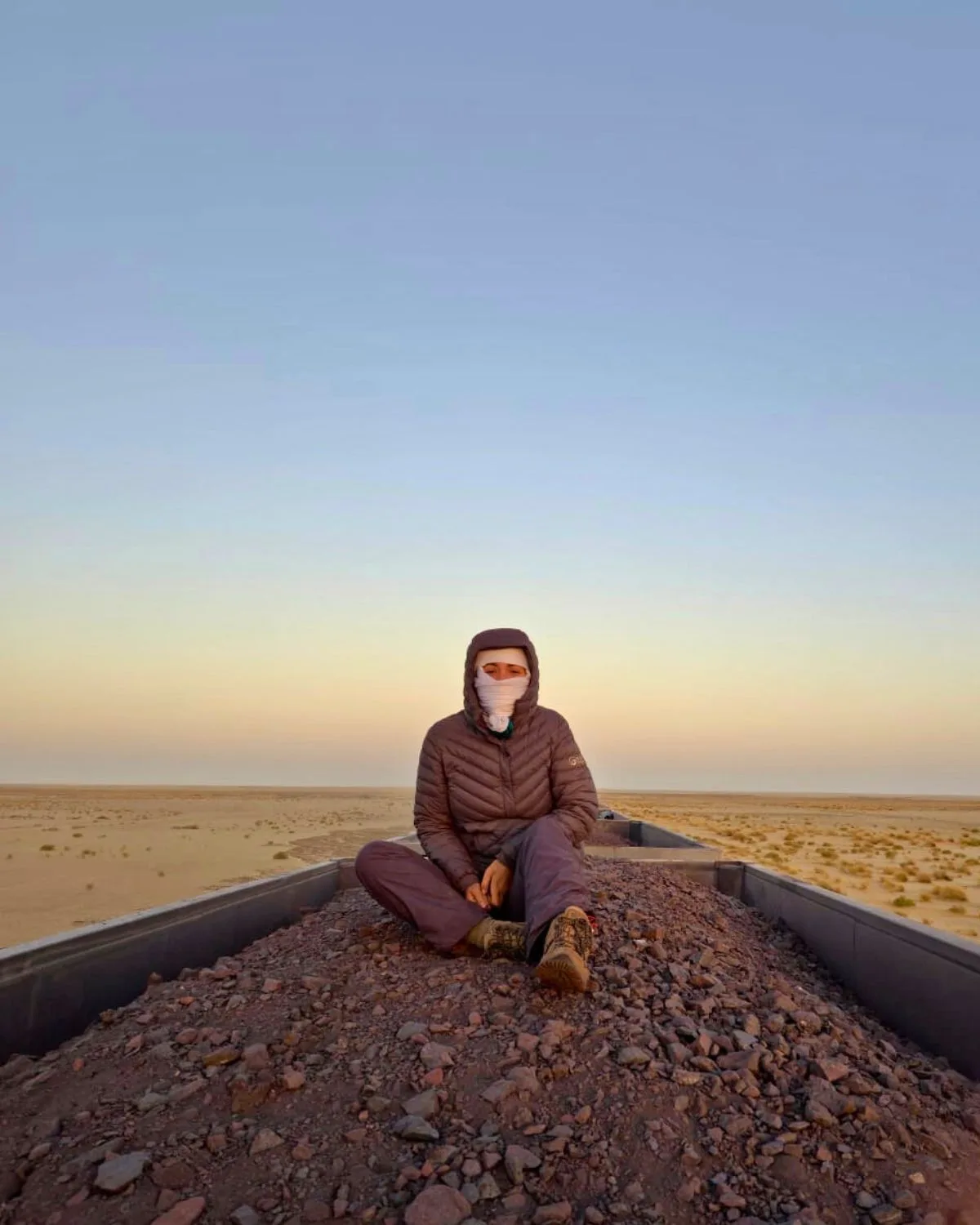
I loved the Mauritania train ride across the Sahara desert, but it wasn’t easy. Freezing nights and howling winds made it one of the most uncomfortable nights of my life. It was an incredible experience, though, a once-in-a-lifetime expedition that has cemented the journey into my memory forever.
In this post, I’m sharing all the details I learned from my trip about riding the iron ore train in Mauritania so you can plan your visit accordingly! If you want a complete travel guide to visiting Mauritania, I’ve got that too!
I’m Going On An Adventure contains affiliate links and is a member of the Amazon Services LLC Associates Program. I will earn a small commission if you purchase through any qualifying links at no extra cost to you.
Mauritania Train Route Map

© Vuxi, CC BY-SA 3.0, via Wikimedia Commons
The Mauritania iron ore train departs from Zouerat (also spelt Zouirat or Zouerate), a town in north-central Mauritania. Zouerat is the country’s iron-ore mining hub and is accountable for the majority of Mauritania’s export earnings.
After departing Zouerat, the “train du desert” heads west to the coast. It usually, but not always, stops in a settlement called Choum and, sometimes, the village of Tmeimichat before finally arriving in Nouadhibou.
It is possible to catch the train in both directions.
I was told that on Fridays, the train stops at all villages along the railway to provide them with water. If you’re interested in Monoliths, the town of Ben-Amera is home to the second-largest in the world!
⭐ Pro tip >> Did you know two types of iron ore sand get loaded onto the carriages? Red and black. If you want to ride on red sand, you’ll need to catch the train loaded from the TO14 site while loading from G. E1 RHEIN will give you the black sand – which is what we had.
🏨 Accommodation // Where To Stay In Mauritania // 8.7+ ratings
Nouakchott: Auberge Triskell | Terjit: Camp Jemal
The Train Itinerary (more or less)
At various points during the trip, I was told many things about the train times. By the end, we were under the impression that three trains run a day as long as the containers are full: supposedly, at 1 pm, 7 pm, and 10 pm. However, delays and disruptions can mean changes in schedule.
That said, I’m still not convinced these are the correct times.
The train I caught arrived at Choum at 10 pm. It arrived on time (ten past ten), which meant we saw the stunning sunrise.
- The train will depart from Tazadit Station in Zouerate and stop at F’derik Station for about 10 minutes (heads up—this stop can apparently last up to a couple of hours).
- The next stop is Choum. You’ll have about 10 minutes to get on.
- Sometimes, the train stops in Tmeimichat. This stop is also meant to be a quick stop, but it can last a couple of hours.
- On a Friday, expect more stops at the villages along the railway as the train provides water.
You might also be interested in
- The (kind of) deserted city of Chinguetti is worth a visit
- Safety in Mauritania is important; read this article to find out more
- One of my favourite parts of Mauritania was visiting an oasis
- Follow my 5-day itinerary and visit the best of Mauritania.
Catching The Mauritania Iron Ore Train: Step By Step

✈️ MAKE TRIP PLANNING EASY!
The All‑In‑One Digital Planner is your simple way to keep every trip organised. Track bookings, plan your days, manage your budget, and tick off checklists – all in one colour‑coded Google Sheet you can use again and again. 🤗
Before I crack on sharing my Mauritania train ride experience and all the other important information, I’ve provided a practical step-by-step guide on how to catch the train below.
If you only read part of this post, make sure it’s this section!
Step 1: Arriving in Mauritania’s capital
The capital of Mauritania is Nouakchott, and you’ll most likely arrive there unless, like us, you’re overlanding Africa. If I’m frank, Nouakchott wasn’t that great. Apart from the Camel Market, Fish Market (Port de Peche), and National Museum, there’s not much more to see/do.
🌟 My top pick >> Join this Private full-day tour of the capital to discover the top attractions, including the National Museum of Mauritania, Fish Market and Camel Market, and learn about Mauritania’s culture and heritage from a local guide.
I don’t recommend staying too long in Nouakchott; instead, head inland and experience the Desert Triangle: Terjit Oasis, Chinguetti and the iron ore train (you could also visit the city of Ouadane).
Apply for an e-visa online before entering Mauritania – here. The e-visa costs €55 or $60 and must be paid on arrival in Mauritania in exact cash in Euros or US dollars – change is not given.
I should probably mention that there is also an airport in Nouadhibou, which is the final destination for the Mauritania iron train. You can jump on the empty train at Nouadhibou eastbound to Zouerat.
Hotel shoutout >> I stayed in the Auberge Triskell Hotel in the heart of Nouakchott. It’s styled with a bohemian vibe. Although it is a little run-down, it was still a great stay. The owner was very helpful in providing information for my journey to Terjit –stay at Camp Chez Jemal
Step 2: Choose your route: Zouerat, Choum or Nouadhibou

The Mauritania iron ore train can be picked up at three locations. If you want to ride a fully loaded train, head to Zourate or Choum. For the empty carriages, head to Nouadhibou.
I caught the iron train in Choum, a small town near the Mauritania/Western Sahara border.
If your flight lands in the capital, you have two options for travelling inland: a private taxi or a local minibus (also known as a shared taxi).
The easiest way to arrange a taxi to Zouerat or Choum is through your hotel. They can provide you with details of a reliable driver. The journey time to Zouerat is around 9 hr 20 min (743.5 km) via road N1, while Choum is 7 hr 10 min (551 km) via road N1.
❤️ FOLLOW ME ON SOCIALS!
I hope you’re finding this guide helpful! Follow me on Instagram (@abigailcarolina.dalton) and Facebook for daily stories, travel tips and photo dumps!
Your support means the world to me. Thank you 🤗

NOUAKCHOTT TO ZOUERAT
If the plan is to use local transport, there is a bus departing in the morning, which is meant to leave between 7 – 8 am (but it can be delayed); however, I suggest getting there earlier, 6 am, to be safe. It will transit through Atar town, where a stop is made for lunch before continuing to Zouerat. Generally, arrival in Zouerat is about 9 pm.
This bus will also pass through Choum and make a stop.
Where can I ride the train in Zouerate? The official station is Tazadit Station; however, if the train is loaded from G. E1 RHEIN (with the black sand), you can head directly to F’derick and ride from there. F’derick is a small village about 30 km from Zourate and closer to Atar.
NOUAKCHOTT TO CHOUM
If you plan the Mauritania train ride from Choum, you can catch the morning bus mentioned above. There is also an afternoon bus from Nouakchott, which departs at 3 pm and stops in Atar before heading to Choum.
Realistically, the bus will arrive in Choum very late, which isn’t so great as it’s likely the train has already passed, so you’ll need to spend the night waiting for the next train.
Instead, a better idea is to stay the night in Atar and catch a bus to Choum the next day. Supposedly, there is a 3 pm bus from Atar to Choum that should arrive at 5:30 pm, leaving plenty of time to explore Atar, purchase any last-minute necessities (packing list below) and be in Choum in time for the evening train.

Alternatively, I went from Nouakchott to Terjit, a palm oasis. I combined my trip with a visit to the ancient city of Chinguetti before heading to Choum in a private taxi. This Desert Triangle is a really incredible way to experience the best of Mauritania, and if you have time, it makes for the best itinerary.
⭐ Pro tip >> I recommend catching the iron train from Choum. The journey is about 14 hours instead of 20 hours (from Zouerat), which, if I’m honest, is much better. Truth be told, it’s not a very comfortable journey at all, so the less time you spend on it, the better.
NOUAKCHOTT TO NOUADHIBOU
The final place to catch the Mauritania iron ore train is Nouadhibou, Mauritania’s second-largest city. It’s a complete dump if you ask me; I was not impressed. However, it is the train’s final stop, where the iron ore gets transferred to the ships for transport.
If you want to catch the train inland, this is where you’ll need to go. As mentioned, there is an airport here; otherwise, there will be buses and taxis from Nouakchott. By private car, it’s around 6 hr 15 min (480 km) via road A. Nouadhibou/N2
The station is outside the city. To get there, take a taxi and tell the driver to drop you off at Le Gare or “station de train.” The station is a white building that includes a police checkpoint, a shop, and a ticket office for buying the passenger wagon (which we don’t want).
Step 3: Jumping on the Mauritania iron ore train

Once you’ve decided on your route, the next step is actually to get on the train. It’s kind of hard to say precisely when the train will turn up, and many people will tell you a different story. We were told there was a 1 pm, 7 pm and 10 pm train from Choum, and the latter was the one we went for. Miraculously, it turned up just 10 minutes past 10 pm.
The stop point is where the main road crosses the rail tracks, so make sure you’re hanging around this area, as the train doesn’t stop for long.
This next part is super important!
When the iron train does stop, you’ll have about 10 minutes to get on. It’s plenty of time, but make sure you don’t follow a local who tells you to go with him and then directs you to the passenger cart at the rear of the train.
Below, I’ll explain what happened to us, but please be sure to jump on one of the containers and ignore anyone who tells you not to.
⭐ Pro tip >> Ideally, count 15 containers after the passenger cart or 13 containers from the front of the train, or at least that’s what I was told. Each container is easy enough to climb up as there is a ladder, but it is a little tricky to carry backpacks and water.
Things to know BEFORE riding the iron train
- It’s bloody freezing, and I mean freezing. The wind is unforgiving, and if you’re riding through the night, be prepared.
- Essential items: a turban, a coat, gloves, sunglasses (I don’t think there’s a need for ski goggles), snacks and water.
- You WILL get dirty. There’s no escaping the dust, and whether you’re black or red, you’ll finish covered in soot.
- The train ride is illegal, and if something happens, like an injury or you fall off, no one’s coming to help.
- There are no facilities if you’re riding on top. The only squat toilet is in the passenger cart at the rear of the train.
- Riding atop the train is FREE. But you’ll have to pay 250 for the passenger cart.
The Mauritania Iron Ore Train Experience
My Mauritania train ride was an adventure like no other. I teamed up with two Polish travellers, Matt and Marcin, whom I met in Terjit Oasis. We faced a mix of chaos and excitement, from almost missing the train to enjoying the sunrise over the desert.

My Story
From start to finish, my time in Mauritania was a whirlwind of excitement, confusion and admiration. I had a wicked time, connected with wonderful people and riding on the world’s longest train (704 km / 437 miles) was wild.
As far as train journeys go, this was the most thrilling I’ve ever had. It even beats the time I almost died on my first overnight train in India!
Before I caught the iron ore train, I went to Terjit and explored the oasis. The plan was to catch the train solo; however, I was hoping to meet some backpackers along the way, and as luck would have it, I did. It’s lucky because Mauritania isn’t exactly a tourist hub, and I was travelling out of season.
Enter Matty and Marcin, two Polish guys who just happened to be in Terjit and on their way to ride the train! I felt pretty lucky. With my social skills turned to maximum, I began convincing them to delay their trip an extra day and join me in Chinguetti before catching the train together.
Evidently, I am a good persuader.

What happened when we tried to get on the train
After an epic desert expedition, we finally reached the small settlement of Choum. We were told a train would arrive at 10 pm, which suited us perfectly since we got there around 7:30. But this is Africa, and trains are notoriously late, early, or sometimes don’t show up at all.
We grabbed some snacks and slowly made our way to the crossing where the train would stop. We waited for about an hour, during which a couple of smaller trains passed, getting us excited each time. Eventually, we heard a low rumbling in the distance.
Getting on the train was a rush! We ended up following a local guy who kept saying, “Come with me.” We thought he was taking us to the best container, but instead, we ran the entire length of the train to the passenger cart at the rear.
Between being out of breath and very confused, I was annoyed. Why? Because he knew what we wanted and intended to charge us for the passenger cart. At one point during the run, Marcin tried to get on one of the containers, but the man shouted, “No, follow me.” So, we did.
Outside the passenger cart, we tried to explain that we wanted to go up top but were told it was impossible. The man collecting payment for the passenger cart was demanding money. Amidst the chaos of everyone else trying to get on and us trying to walk away, the train started moving!
Fuckkk.
Enjoying this blog? All my content is free, but I do spend a lot of time in coffee shops. If you’re finding my content helpful and would like to buy me a coffee, I’d love that! Thank you 🤗
Jumping on the Mauritania iron ore train
Panic set in, and the only thing we could do was jump into the passenger cart. It wasn’t where I wanted to be, and by this point, I was fuming but also laughing. It was funny because, in the mad scramble to get onto the train, Marcin split his trousers right across the groin. Waddling around the carriage with a look of bewilderment, Matty and I found it hilarious.
I was the last one up—so much for chivalry. I thought I might not make it up the ladder as the train was already moving, but I managed to haul myself up with my trousers intact.
Cooped up in a small, cell-like carriage, the realisation that this might be a completely wasted journey made me extra salty. But I refused to give up, and once everything had calmed down, I tried talking to the conductor again.
“No, illegal, impossible, and dangerous,” he kept saying, demanding payment.
In the end, he just wanted money. After we paid the 250 MRU/$6, miraculously, we were told that at the next stop, we could move outside. So, at 1 am, when the train pulled up at what I imagined was Tmeimichat, we dashed the containers. Hauling ourselves up, we finally made it.
Moral of the story: Persistence and a bit of humour can get you through even the most chaotic adventures.
What to expect to see on the journey
- Desert, Dust, and Camels: You’ll see plenty of all three. The Sahara’s landscape is vast and barren, but its raw beauty is stunning.
- Sunrise or Sunset: Both are spectacular. The sky transforms into a canvas of colours, making the endless desert even more breathtaking.
- Nomadic Life: As the train plods along, you might spot a few nomadic tents and herds of wild camels. The occasional tree and sparse shrubbery are the only signs of vegetation in this arid land. It’s pure, raw, and unfiltered.
- Starry Night Sky: In the evening, the sky turns into a blanket of twinkling stars. It’s a magical sight that makes the cold night a bit more bearable, though it’s still freezing and extremely windy. Trying to sleep in such conditions can be a nightmare, especially if you’re not adequately prepared.
- Incredible Sunrise: Despite a sleepless night, the sunrise is worth it. We were joined by a local, and all four of us were up to watch it. It was pretty incredible!
Where To Start The Journey?

I suggest starting the train ride in Choum. It’s easier to get to than Zouerate since it’s closer and will be more affordable if you’re catching a private taxi directly.
The journey from Zouerate to Choum is an extra 6 hours, which is an unnecessary addition to an already long trip.
From Choum, we experienced the evening and morning, the starry night and sunrise; 14 hours on the train was enough!
And What About Nouadhibou…
I wouldn’t say I liked Nouadhibou. I found the city ugly, with no cultural highlights or sightseeing.
The children playing outside our hostel were rude – one of them shouting out, for no apparent reason, “You motherfucker” when we walked past. We also had a number of them jump onto our tuk-tuk as we drove out and damaged it. With about eight refusing to get off, it nearly turned into a ruckus.
In truth, I wouldn’t advise catching the train from Nouadhibou. The empty carriages detract from the excitement of riding up top, and you won’t get to see the scenery. I also read that they are extremely hot – like an oven – during the day and just as cold in the evening.
But then again, it’s a feasible option if you’re looking for a cheap way to get to central Mauritania.
The Passenger Cart Vs. The Containers

The passenger cart is not great. It’s enclosed and somewhat claustrophobic. It’s all metal, even the seats. Cold and dismal, with tiny windows in each carriage. It’s not somewhere I’d want to spend any time.
That said, along the passageway, there were more oversized windows, and possibly, during the daytime, it would have been airer.
We met some friendly people inside, and we sat and chatted for a while. Before moving outside, we were also given a few cups of green tea, which was well received.
The toilet? Well, there is a hole, but it’s not somewhere for the faint-hearted. Best avoided.
The containers, on the other hand, are not much better! Uncomfortable, windy, dusty and cold, this is a trip for the adventurous soul if I ever found one. But it’s fun and exciting and most definitely where you want to be.
How Long Does It Take?
Time varies depending on where you jump on the train (and if there are any delays). But let’s just say the trains are running smoothly, and there are no disruptions.
- Zouerate to Nouadhibou is 20 hours
- Zouerate to Choum is 6 hours
- Choum to Nouadhibou is 14 hours
- Nouadhibou to Choum is 14 hours
- Nouadhibou to Zouerate is 20 hours
How Safe Is Mauritania’s Iron Ore Train?
The iron ore train in Mauritania is not safe in the sense that there is no regulation, and it’s technically not a legal activity for tourists. There’s no official help if something goes wrong, and long delays are expected. If you fall off mid-journey, the train doesn’t stop.
There is nowhere to purchase water or food, so you must take everything you need with you. There are also no toilets, apart from in the passenger cart.
You must be careful when taking pictures, especially if you’re sitting on the side. I would advise against taking any dangerous or “cool shots” near the side of the containers; instead, remain firmly within the container.
Can it be done alone…yes, should it be?
I was planning to ride the Mauritania iron ore train solo, but I was apprehensive. Going solo always has its cautions, even more so on this type of adventure.
Mauritania itself is an off-the-beaten-path destination, and the iron ore train is not for the faint-hearted, often filled with men returning home from working the mines.
Is it safe for women? In my experience, it was completely secure, and I haven’t heard of any problems. Then again, I’ve not met any solo female traveller to ask.
I would have done it solo, and I believe it would have been fine, but I felt much better having Matty and Marcin with me. I also wouldn’t have caught the night train, but instead, I would have aimed for the earliest train to ride through the day.
The Best Time To Ride The Mauritania Iron Ore Train

The best time to ride the iron ore train is typically during the winter season, which is November to April, as the temperatures are manageable. However, it’s possible to ride the train throughout the year.
Mauritania experiences a hot desert climate. The landscape is arid and dusty, with high temperatures, and it hardly sees any rainfall. If it does rain, it’s brief and intense thunderstorms in the south, usually between July and September.
I rode the Mauritania iron ore train in April. Even though this is considered the best time, it was still freezing and windy at night, and the wind continued throughout the day.
Mauritania has two seasons: Cool and Hot. Depending on the season, there are a few things to consider.
Winter (cool season):
- When: November to April
- Weather: Mild days with cooler nights. Daytime temperatures range from 25°C to 30°C (77°F to 86°F), while nights can drop to around 10°C (50°F) or lower in some areas. Ideally, daytime travel is best for this season.
Summer (hot season):
- When: May to October
- Weather: Extremely hot, especially during the day, where temperatures often exceed 40°C (104°F). Nights stay warm, usually around 25°C to 30°C (77°F to 86°F), so nighttime travel is best during this season.
- Avoid June and August as the heat is too intense.
The transitional months of April-May and October-November are also quite hot but a bit more bearable compared to the peak summer months.
Everything Else | How To Ride The Iron Ore Train

How much does it cost to ride the iron ore train in Mauritania?
If you want to ride in the passenger cart, the iron ore train costs 250 Mauritanian Ouguiya (MRU), which is about €6.
To ride in the containers outside is entirely free!
Can you ride the train in the opposite direction?
Mauritania’s iron ore train can be ridden in both directions: Zouerate to Nouadhibou and Nouadhibou to Zouerate. Keep in mind the latter will have empty containers.
Food & drink on Mauritania’s iron ore train?
There is no food and drink on the iron ore train. This is not a tourist attraction but a functioning commercial train transporting iron ore. There are no facilities except a small squat toilet in the passenger cart.
You will need to take all the food and drink with you. I recommend at least 3 to 4 litres if you’re doing the entire journey.
As for food, make sure you have all the grub you need with you. Eating can be difficult as it’s very dusty, and there’s nowhere to wash your hands aside from over the side with your drinking water. I suggest packing dry food like bread and biscuits, which are easy to handle and unlikely to cause stomach upset.
Pro tip >> I bought 5 litres from the shop in Chinguetti to top up my water bottle. However, I didn’t drink it all, I think because we were travelling at night. If you’re travelling during the day, you will certainly need more water to stay hydrated.
What to pack for the iron ore train in Mauritania?
- Turban – essential
- Sunglasses – essential
- Headlamp – essential
- Mat – essential
- Coat – essential
- Blanket (only if your jacket isn’t warm enough)
- Lighter
- Water – Take at least 3 to 4 litres. One of the 5-litre bottles is a good choice!
- Food – You’ll need enough for the entire journey, as there is nowhere to buy snacks.
- Money – Take cash to buy water and food.
- Entertainment – music and books are great.
Are there toilets on the train?
There is one toilet in the passenger cart; however, unless you’re in the passenger cart or the train is on a long stop, you cannot access the toilet if the train is moving.
For men, it’s easy to go over the side, but for us women, it poses a bigger problem. If you’re concerned, consider purchasing a female urinal. You might also not be alone in the container, and privacy will be an issue if so.
We were joined by a young lad, who was great, but had I needed to go, it would have been challenging. Thankfully, I must have been pretty dehydrated as I lasted the whole trip. I’m not suggesting that dehydration is a good thing, but for this, it was.
Can I sleep on the Mauritania iron train?
The iron ore train is not made for tourists; it’s a working train that transports iron ore from central Mauritania to the coast. Therefore, there are no official sleeping facilities.
If you wish to ride in the passenger carriage and grab a bench, you can sleep there. Outside, in the containers, you sleep under the stars on a bed of iron ore. It’s not comfortable, but you will manage to get some shut-eye. It’s essential to take a mat; we picked a bamboo one from the local market.
Reasons You Shouldn’t Catch The Iron Ore Train
This journey is for the adventurous traveller. It’s uncomfortable, dusty, and long, but if you love unique experiences and can handle harsh conditions, it’s worth it.
- It’s uncomfortable, windy and very cold.
- It’s dusty, and you will get dirty.
- There are no toilet facilities.
- Getting to Choum/Zouerate is a long journey.
- Expect long wait times and possible breakdowns.
- There is no health and safety.
- It is illegal.
Mauritania’s Iron Ore Train
In the 1960s, iron ore mining began in Mauritania and now contributes significantly to the country’s GDP. It’s the main economic driver. Production is managed by the SNIM (Société Nationale Industrielle et Minière) at iron ore mines in Zouerate, in the Tiris region of Mauritania. About 12 million tonnes of ore are transported by train each year from the mines to Nouadhibou.
The SNIM company primarily operates two types of deposits in the Tiris region: hematite and magnetite.
How much does an iron ore train carry?
An iron ore train in Mauritania can carry up to 16,800 tonnes of iron ore per trip. Each train consists of 200 to 210 cars, with each car carrying up to 84 tonnes of iron ore.
How long is the longest iron ore train in Mauritania?
The longest iron ore train in Mauritania can be up to 3 kilometres (1.9 miles) in length, making it one of the longest and heaviest trains in the world.
Where does the iron ore train go?
The iron ore train travels from Zouerate, a small mining town near the Mauritania/ Morocco border, to the second largest city in the country, Nouadhibou. It stops in Choum, which is where I suggest jumping on, and a few other villages. This route is crucial for transporting iron ore for export.
⭐ Pro tip >> If you’re going to be using your phone, don’t forget about overseas data roaming. You’ll get charged for using your data. Try Airalo’s eSIMs and download a digital data pack. It’s quick and easy; great if you’re in a hurry.
🚑 DON’T FORGET TRAVEL INSURANCE!
SafetyWing is a fantastic travel medical insurance that is super affordable and great for backpackers. You can purchase a policy before or after your travels begin. 🤗

Final Thoughts | Riding The Iron Ore Train Mauritania
Riding the iron ore train in Mauritania is not for the faint-hearted.
It’s a challenging but rewarding adventure that offers a unique look at the Sahara and Mauritania’s mining industry. If you’re up for an unforgettable experience, this is it!

Explore & Discover More
Come and join our socials and keep up to date with the latest adventures. Find the latest travel blogs and photo updates, ask questions and get travel inspiration.
✔️ FIND ON INSTAGRAM
✔️ JOIN US ON FACEBOOK

